
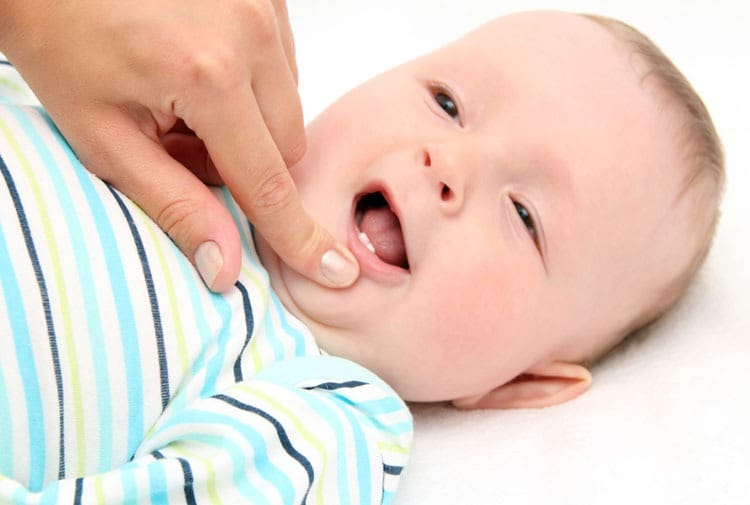
Teething is the process when a baby’s first (primary) teeth emerge through the gums. They usually arrive in a set pattern, in pairs. Signs of teething often occur a while before the first teeth appear.
A baby’s first teeth – known as primary, baby or milk teeth – start to form during pregnancy, when the baby is developing in the womb. These are almost completely formed at birth and are hidden in the gums when a baby is born. There are 20 primary teeth: 10 on the top row and 10 on the bottom row.
Primary teeth are very important because they help your baby learn to chew and speak, and they also make space in the jaw for the permanent one’s that come in later.
When do babies begin to get teeth?
A baby’s primary teeth usually start to come through the gums between 4 and 10 months of age, but some babies start to get them earlier or later than this. Some babies are even born with one or more teeth showing.
In what order do the teeth appear?
The two middle bottom teeth (called the central incisors) are often the first ones to appear. By the time they are 12 months old, most babies have eight front middle teeth (four incisors on the top row and four on the bottom row). The upper and lower molars (the bigger ones towards the back of the mouth) tend to come through next, followed by the canines (the ones between the incisors and the molars). Finally, the back molars (the last at the back) come through.
It usually takes around two and a half years for all of the primary teeth to be visible. If none have appeared by 12 months, a dentist should be consulted.
What happens when a tooth breaks through the gum?
When a tooth is about to break through the gum, the skin over the tooth may become red and swollen, and the gum may feel hard. While some babies have no trouble when teeth come through the gums, other babies find the teething process painful and uncomfortable, and may become very upset.
Babies who are teething may:
- Have trouble sleeping
- Have red cheeks
- Put their fists or other objects into their mouths to rub the area where the tooth is coming through
- Dribble more than usual (this may also cause a rash on the cheeks or chin)
- Cry and fret more than usual
- Eat less that they usually do
- Have swollen, red and tender gums.
Teething does not cause diarrhoea or a fever.
Talk to your doctor or community nurse if your baby has any symptoms that are worrying you.
When should I start cleaning my baby’s teeth?
It is important to start cleaning your baby’s teeth as soon as they appear, even if they only have a few teeth. Dentists recommend that your brush your baby’s teeth with a soft brush and no toothpaste until they are 18 months of age, then start using children’s toothpaste.
When should my child start going to the dentist?
It’s a good idea to start seeing the dentist when your baby is around 12 months of age. They won’t have all their primary teeth yet, but early dental care is important to help prevent tooth decay and monitor how the teeth are growing. The dentist can also help you with brushing techniques for your baby’s teeth.
When do children get permanent teeth?
The primary teeth usually start to fall out at around 6 years of age to make way for the permanent or adult teeth. The first permanent teeth to appear are usually the lower first molars (often called the ‘6-year-old molars’), followed by the front (incisor) teeth. A child usually has all of their permanent teeth by the time they are 13 years of age, but if the third molars (wisdom teeth) come through, this may take longer.
How can I help my baby when they are teething?
If your baby appears to be in pain, it may be helpful to:
- Rub or massage your baby’s gums with a clean finger or a soft cloth: this can help to ease pain.
- Give your baby something cold (but not frozen) to suck or chew on, for example, a chilled teething ring. Do not put frozen rings or other frozen objects directly on the gums.
- If your baby is eating solids, some unsweetened rusks or sugar-free biscuits may help to relieve pain.
- Wipe away excessive dribbling with a clean washcloth: this can help to prevent skin rashes. Applying a protective barrier cream to the area can also help to prevent skin irritation.
- Occasionally, babies may require pain relieving medicine such as paracetamol or ibuprofen to control pain. Use strictly as directed on the bottle. Check with your doctor or pharmacist before giving your baby any medicines.
What not to use
Do not use honey, jam or other sweetened products on the gums as they can cause tooth decay. (Honey should never be given to any child aged less than 12 months of age because it poses a risk of serious food poisoning.)
Do not use necklaces because they are a choking hazard.
Gels are also not recommended, in particular, ones that contain the ingredients choline salicylate (a type of aspirin, which should not be given to babies or children) or benzocaine.
There is a lack of evidence to show that complementary teething remedies are effective. There is no evidence that the following are helpful for teething: aconitum, actaea spicata, belladonna, chamomilla, calcarea phosphorica, colocynthis, kreosotum, merc sol, nux vomica or silicea.
Clove oil is not safe for use in babies or children and is not recommended for the treatment of pain.
When to see a doctor about your baby
Teething may cause your baby to be uncomfortable but it does not cause serious illness. Take your baby to the doctor if your child has a high temperature, diarrhoea, sore ears, is not drinking, or seems unwell.
